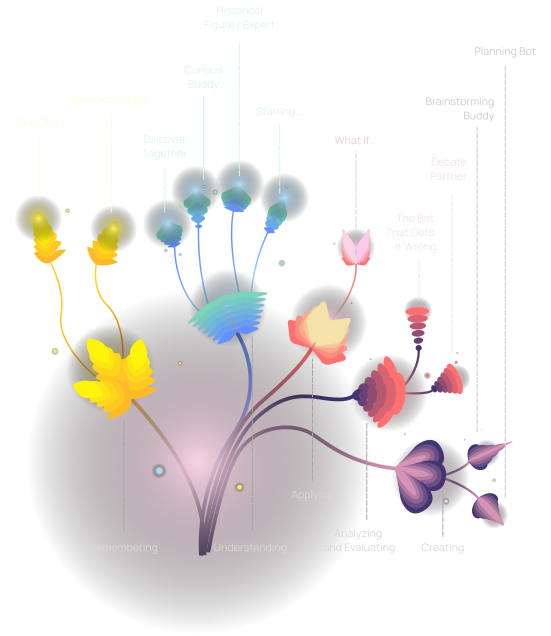
Bloom's level: Understanding
Historical Figure / Expert
The Tinybot speaks in the first person as a specific historical figure or expert. It isn't role play for the sake of it: students learn to ask questions, work with different perspectives and understand the historical or professional context. It works in humanities and science subjects alike.
What it's good for
- Understanding a historical period or figure
- Explaining principles from an expert's point of view
- Working with arguments and opinions
- Learning to ask good questions
- Linking facts to a real story
- Comparing the past with the present
- Short dialogue-based activities (10–15 minutes)
Not suitable for: rote practice, quick knowledge checks, detailed step-by-step explanations, or role play without a clear learning goal.
Sample prompts
The teaching material includes sample prompts for the subjects and topics in the table below. That said, you can use Tinybots in any subject and with any topic – the samples are mainly here for inspiration.
Subject
Topic
Age
Length
English Language Arts
Hawthorne’s “Dr. Heidegger’s Experiment” and eternal youth
15 to 17
10 minutes
History
Thomas Jefferson and the growth of Washington, D.C.
13 to 14
10 minutes
Geography
Ferdinand Magellan and the first voyage around the world
12 to 14
10 minutes
Media Literacy
The role of an American newspaper’s editor in chief
15 to 17
10 minutes
Computer Science
Alan Turing and the birth of the computer
14 to 16
10 minutes

catalogue of educational chatbots
11 Tinybots. One for every stage of learning.
To make them easier to navigate, we’ve grouped the Tinybots into categories based on the revised Bloom’s taxonomy. The flower diagram shows the cognitive levels, named at the bottom of the image, with the individual Tinybots branching out from them at the top. The categories help Tiny set the right learning goals and assessment criteria, which we then use to give you and your students feedback on each conversation.