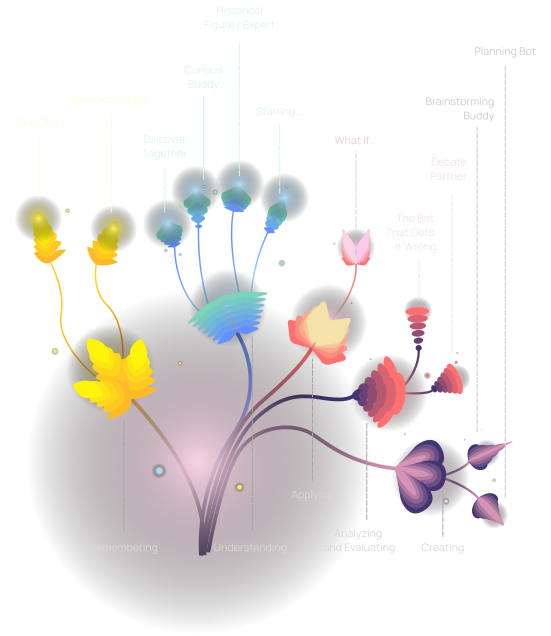
Bloom's level: Understanding
Curious Buddy
A Tinybot that plays a classmate who missed the lesson and doesn't understand the material. The student has to explain it simply and in their own words, and in doing so discovers where they've only memorised things. It quickly reveals gaps in understanding.
What it's good for
- Explaining concepts and principles
- Checking real understanding, not just memorised phrases
- Practising explaining things in your own words
- Finding gaps in understanding of a topic
- Working with causes and effects
- Telling similar concepts apart
- Independent practice at home
Not suitable for: long technical explanations, rote practice, quick knowledge checks, or topics where you don’t expect students to explain things themselves.
Sample prompts
The teaching material includes sample prompts for the subjects and topics in the table below. That said, you can use Tinybots in any subject and with any topic – the samples are mainly here for inspiration.
Subject
Topic
Age
Length
English Language Arts
Complete sentences vs. sentence fragments
12 to 13
10 minutes
Math
Percents (whole, increase, and decrease)
13 to 14
10 minutes
Geography
Why climate differs around the world
12 to 14
10 minutes
Media Literacy
How to tell if a source is trustworthy
15 to 16
10 minutes
Computer Science
Storing data (files and folders)
10 to 12
10 minutes

catalogue of educational chatbots
11 Tinybots. One for every stage of learning.
To make them easier to navigate, we’ve grouped the Tinybots into categories based on the revised Bloom’s taxonomy. The flower diagram shows the cognitive levels, named at the bottom of the image, with the individual Tinybots branching out from them at the top. The categories help Tiny set the right learning goals and assessment criteria, which we then use to give you and your students feedback on each conversation.