Bloom's level: Understanding
Starring…
The Tinybot becomes an object, phenomenon or concept – a cell, light, a river, a data packet – and tells its story in the first person. It explains things through concrete situations and comparisons. Great for bringing abstract topics that are hard to picture to life.
What it's good for
- Biology: the cell, the heart, a virus, an ecosystem
- Physics: light, an electron, a magnet
- Chemistry: atoms, molecules, reactions
- Geography: a river, a volcano, a glacier
- Astronomy: the Sun, a planet, a comet
- Abstract concepts and processes in general that are hard to picture
Not suitable for: detailed technical explanations, knowledge checks, memorising facts, or human historical and social perspectives – for those, use Historical Figure / Expert.
Sample prompts
The teaching material includes sample prompts for the subjects and topics in the table below. That said, you can use Tinybots in any subject and with any topic – the samples are mainly here for inspiration.
Subject
Topic
Age
Length
Geography
El Niño
13 to 15
10 minutes
Math
Cones: properties and volume
13 to 14
10 minutes
Spanish
Present perfect in Spanish (pretérito perfecto)
17 / B2
10 minutes
U.S. History
The Declaration of Independence
13 to 14
10 minutes
Computer Science
Data packets
13 to 15
10 minutes

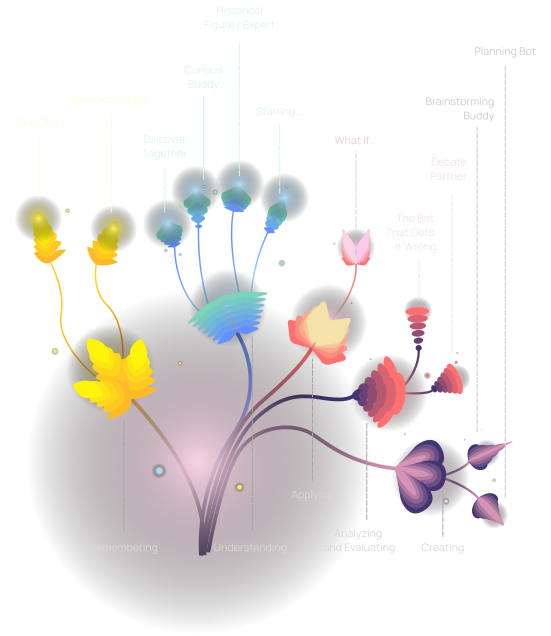
catalogue of educational chatbots
11 Tinybots. One for every stage of learning.
To make them easier to navigate, we’ve grouped the Tinybots into categories based on the revised Bloom’s taxonomy. The flower diagram shows the cognitive levels, named at the bottom of the image, with the individual Tinybots branching out from them at the top. The categories help Tiny set the right learning goals and assessment criteria, which we then use to give you and your students feedback on each conversation.