Bloom's level: Applying
What If…
The Tinybot sets up a hypothetical change and uses follow-up questions to help students think through the consequences. It links causes and effects in a chain, so students apply what they know to a completely new situation. A good warm-up before a discussion or project.
What it's good for
- Applying what students have learned to new situations
- Developing cause-and-effect and systems thinking
- Connecting knowledge across topics
- Inquiry-based activities
- Preparing for a discussion or project
Not suitable for: learning new material, memorising facts, purely imaginative stories with no link to the curriculum, or topics where you can’t reason about causes and consequences.
Sample prompts
The teaching material includes sample prompts for the subjects and topics in the table below. That said, you can use Tinybots in any subject and with any topic – the samples are mainly here for inspiration.
Subject
Topic
Age
Length
English Language Arts
Punctuation
12 to 13
10 minutes
Math
Pythagorean Theorem
13 to 14
10 minutes
Geography
Water on Earth
12 to 14
10 minutes
History
The Roman Empire
15 to 16
10 minutes
Computer Science
The Internet
10 to 12
10 minutes

catalogue of educational chatbots
11 Tinybots. One for every stage of learning.
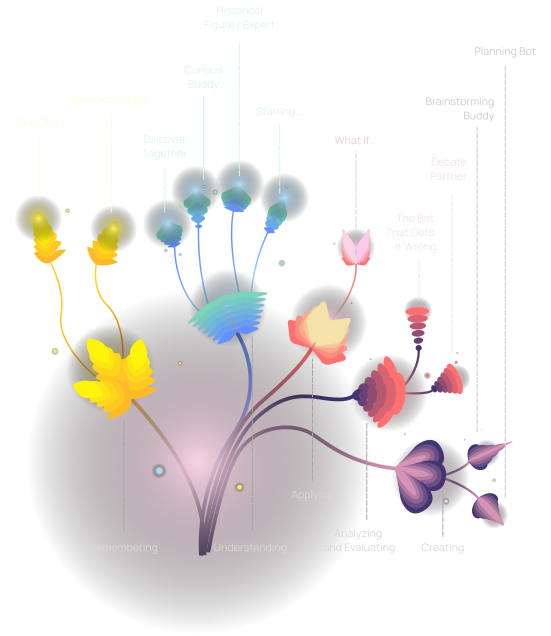
To make them easier to navigate, we’ve grouped the Tinybots into categories based on the revised Bloom’s taxonomy. The flower diagram shows the cognitive levels, named at the bottom of the image, with the individual Tinybots branching out from them at the top. The categories help Tiny set the right learning goals and assessment criteria, which we then use to give you and your students feedback on each conversation.